Advanced Nano Degree in
Industrial Automation
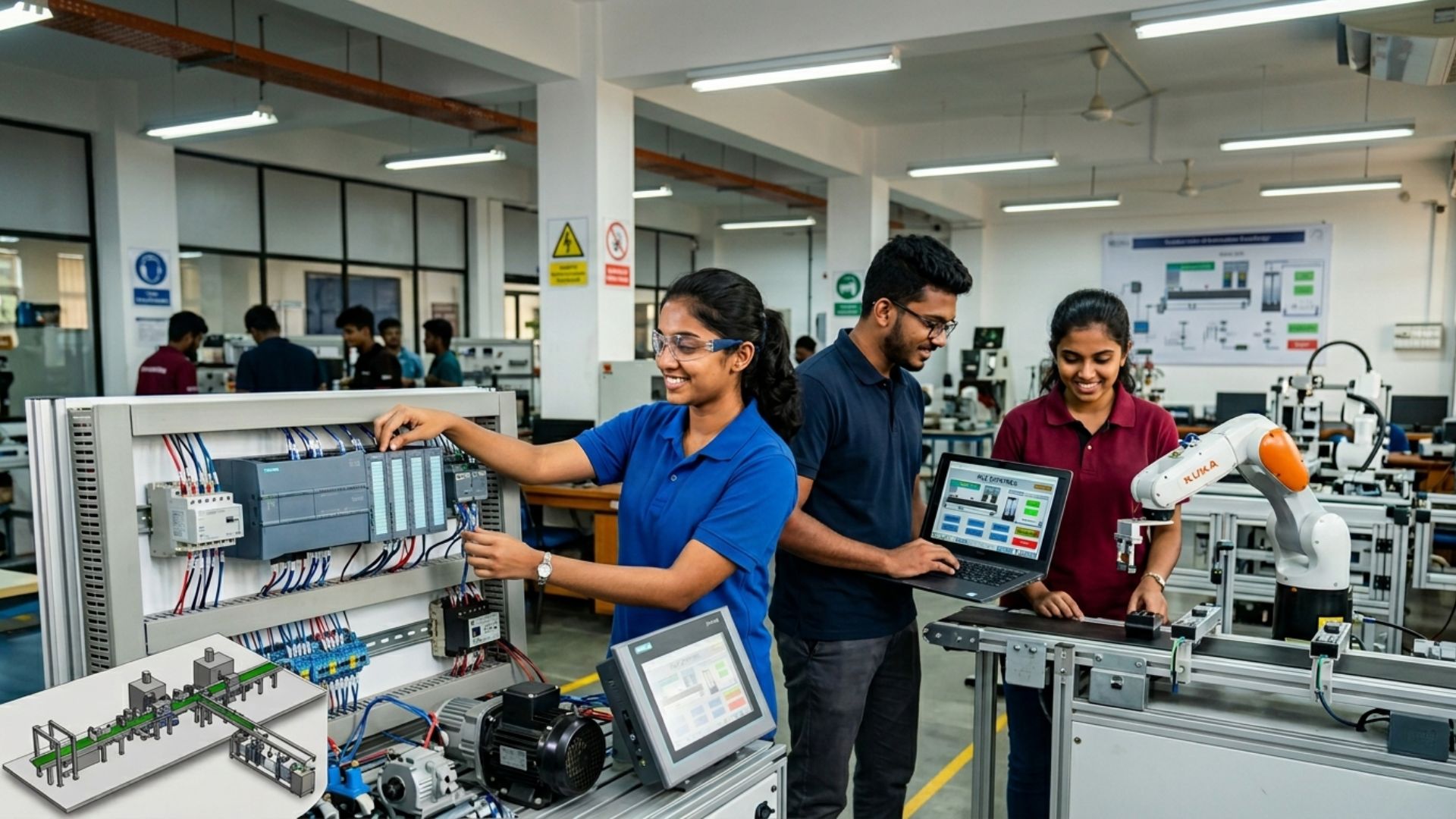
Advanced Nano Degree In Industrial Automation
The course is structured into Four Quarters, totaling approximately 800–1,000 guided learning hours (including lab time)
Quarter 1: The Engineering Foundation
Focus: Safety, Manual Skills, and Basic Electrical/Electronics This quarter ensures all students, regardless of background, have the “shop floor” literacy required for NVQ Level 4.
- Module 1: Occupational Health & Safety (OHS): Risk assessment, LOTO (Lock-Out Tag-Out) procedures, and PPE.
- Module 2: Workshop Technology & Drawing: Manual tool usage (filing, drilling, tapping) and Engineering Drawing (BS 8888 standards/ISO).
- Module 3: Applied Electricity: AC/DC circuits, magnetism, and power factor. Wiring domestic and basic industrial distribution boards.
- Module 4: Applied Electronics: Semiconductor theory, diodes, transistors, and soldering techniques for PCB repair.
Quarter 2: Industrial Control & Fluid Power
Focus: Transitioning from Manual to Automated Control This quarter integrates your “Relay Logic” and “Pneumatics” modules into a broader industrial context.
- Module 5: Relay & Contactor Logic (From your 3-month plan): DOL, Star-Delta, and Forward-Reverse hardwired circuits.
- Module 6: Industrial Pneumatics & Hydraulics: * Pneumatic symbols, 5/2 & 3/2 valves, and cylinder sequencing.
- Introduction to Hydraulic power packs and high-pressure safety.
- Module 7: Sensors & Transducers: Interfacing digital (Proximity, Photoelectric) and analog (Load cells, Thermocouples) sensors.
Quarter 3: Automation & Motion Control (The Core)
Focus: Deep Technical Mastery Here, you insert your specialized PLC, HMI, and VFD training, expanded for industrial robustness.
- Module 8: PLC Programming (Expanded): * Register-style (Xinje) and IEC 61131-3 (Siemens/Schneider) logic.
- Advanced math functions, Analog I/O scaling, and PID control.
- Module 9: Drive Control Systems (VFD & Motion):
- VFD parameterization and speed control.
- Stepper/Servo motor control using Pulse Train Outputs (PTO).
- Module 10: HMI & Data Visualization:
- Designing operator interfaces, alarm handling, and data logging on TouchWin/EasyBuilder Pro.
- Software Tools: Using platforms like Ignition (Inductive Automation) or WinCC.
- Dynamic Graphics: Creating real-time “Digital Twins” of the production line.
- Database Integration: Linking SCADA to SQL databases (like the PostgreSQL/TimescaleDB stack you’ve worked with) for historical data logging and “Report Generation.”
- Module 11: Computer Applications & Networking:
- PC-to-PLC communication via Ethernet and introduction to Modbus RTU (preparing for RS-485).
- Communication Protocols: Practical wiring and configuration of Modbus TCP/RTU and OPC-UA.
- Topology: Designing star and ring networks for industrial robustness.
Quarter 4: Advanced Systems & Professional Practice
Focus: Industry 4.0, Maintenance, and Graduation This quarter aligns with the “Final Year” requirements of CGTTI, focusing on CNC, Robotics, and real-world application.
- Module 12: CNC & Industrial Robotics: * Basics of G-Code and M-Code.
- Introduction to Robot coordinates (XYZ) and basic “Pick and Place” programming.
- Module 13: Microcontrollers (Embedded Systems): Using ESP32 or Arduino for low-cost edge monitoring (IoT bridge).
- Module 14: Maintenance & Troubleshooting: Systematic fault-finding in live panels using multimeters and oscilloscopes.
- Module 15: Workplace Management (NVQ Soft Skills): Teamwork, Workplace Communication, and Project Estimation/Quoting.
- Final Capstone Project: Students must design, wire, and program a “Modular Production System” (e.g., a sorting conveyor with a pneumatic reject arm and HMI dashboard).